

Joe Weisenthal of Bloomberg’s Odd Lots podcast had a post last week that garnered thousands of responses from econ and YIMBY twitter.
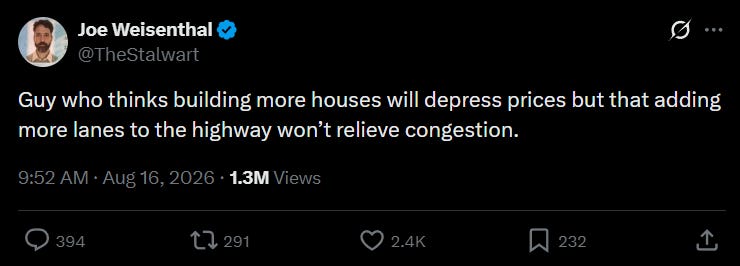
The clear intention of this short tweet is to catch YIMBYs in a contradiction. They support building more houses as a cure for rising housing prices but are suspicious of highway construction as a strategy for reducing traffic.
Ultimately, this is just an offhand remark, but understanding exactly what’s so wrong about it is surprisingly complicated and many responses to Joe’s attempted gotcha, even from economists, are incomplete.
At first, it seems like this tweet is just a claim about demand elasticity. Demand elasticity is the percentage change in quantity demanded caused by a one percent change in price. When it's high, there are lots of people willing to consume more of a good if only its price were a little lower. Supply shifts therefore change quantity a lot but barely move the price. So, if we believe demand is highly elastic for highways and less elastic for houses, then we can easily accept Weisenthal’s double-bind without contradiction.
There is some empirical evidence for this ordering of elasticities as well. Duranton and Turner find that vehicle miles traveled rises proportionally with the stock of roadways in a city. So adding 1% more road area leads to 1% more driving. If congestion depends on the amount of traffic per unit of road, then this suggests that building roads will have no effect on congestion, exactly as predicted by a highly elastic demand for driving. For housing, on the other hand, research more consistently finds that building more houses in a neighborhood or a city lowers nearby housing prices, consistent with a much lower elasticity of housing demand.
It’s fair enough to just end the response here. It’s simply not a contradiction for one good to have elastic demand and another to not.
But there is a lingering problem that left me unsatisfied with these responses.
First of all, it might not be true that demand for housing is inelastic, especially in particularly desirable cities. Indeed many models predict that housing prices rise as housing supply expands. This is because, through some combination of higher labor productivity, easier access to goods, knowledge spillovers, high fixed-cost amenities, and larger social networks, which economists summarize as agglomeration benefits, each person’s own willingness to pay to live in a city rises with aggregate demand. Being the marginal entrant to 200,000 population Sioux Falls is worth much less than being the marginal entrant to a 10,000,000 population NYC. Duranton and Puga predict that expanding housing supply to add 8 million residents to New York City would increase housing prices because of how much higher incomes would be (with a large net increase in welfare).
Second of all, and more fundamentally, the elasticity of demand for housing doesn’t determine how important it is to build more houses. Building extra lanes of highway that don’t reduce congestion is useless, but changing laws to allow more houses that don’t reduce rents, or even that raise them, is a huge gain to national welfare.
To see this requires some supply-demand graphs, starting with the highway market. Supply here is the relationship between the number of commuters on the road and the travel time that trips impose. I’ve drawn this as an upward sloping line to reflect that traffic gets worse as more drivers join a road.
Then you have demand at a downward slope. Note that highways are “free” so price here is not in dollars but in time. The person on the top left of the demand curve, for example, is willing to commute even if it takes them 2 hours, but it only takes 30 minutes so they get a lot of surplus. People keep entering the highway and earning surplus until the last person is just indifferent between the time cost they pay commuting and the benefit it provides.
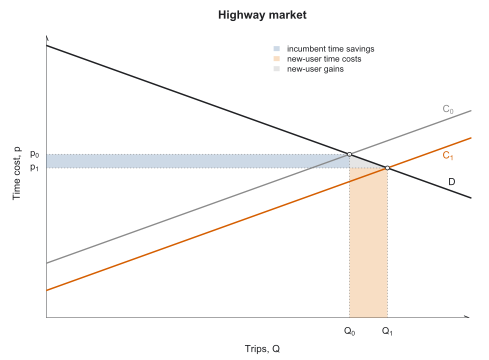
Now consider what happens when we add another lane to the highway and supply shifts right. There are two changes: quantity goes up and prices goes down. The welfare effect of these two changes are represented by the orange and blue rectangles.
The blue rectangle has a width of Q0 and a height of p0 - p1. This counts up all the people who were already commuting before the new lane was added and the time savings they get as a result. Each incumbent commuter gets a bit more distance between the maximum commute they’d be willing to tolerate and what they actually have to endure, so their welfare goes up.
The orange rectangle has a width of Q1 - Q0 and a height of p1. This counts up the time cost paid by all the new commuters who start driving because of the extra capacity added by the new lane. But with a small change to supply, most of these new drivers are right on the edge between commuting and not. There’s not much space between the time they’re willing to spend commuting (the black demand curve) and the time it actually takes (p1). Most of the new drivers brought in by a new lane are just barely willing to pay the time cost to commute, so they only get the small gray triangle of extra welfare from it, which is negligible on the margin.
Now consider a housing market with supply and demand curves set up exactly the same way.
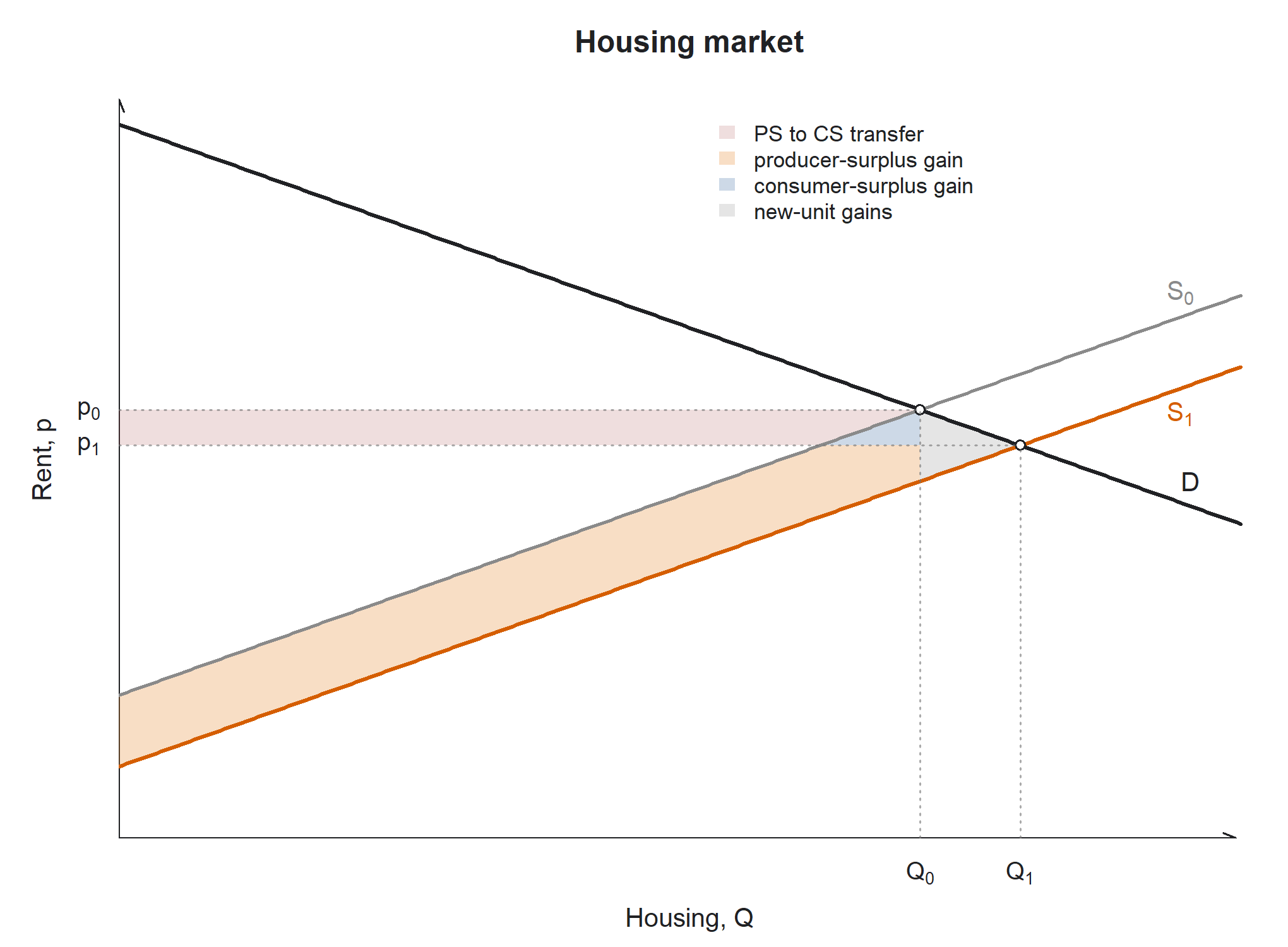
From the consumer’s perspective, nothing has changed. The people in the top left of the demand curve would pay a fortune to live in this city, but the prevailing rent is much lower so they get lots of surplus. The very last person to move to the city is just indifferent and all the value they get from living there is offset by the rent they pay for the privilege.
But the prices have changed from minutes of time to dollars of rent. Unlike with time prices, there is another side to payments in dollars. The entirety of the travel time paid to use a highway is dissipated away as a pure resource cost. But only part of each rent payment goes to the real resource cost of building a house, the rest is enjoyed by suppliers as producer surplus. This separation between price and cost is what makes housing supply shifts valuable even if rent barely changes.
To see this, shift housing supply to the right, perhaps by passing a YIMBY reform. Again, price goes down and quantity goes up. But now, the rectangle representing price savings for existing consumers, which was the only source of welfare gains from highway expansions, is mostly unimportant for total welfare. Consumer surplus goes up, because housing prices decrease, but symmetrically producer surplus goes down so the net welfare effect is zero.
Instead, the net welfare gains are coming from the area in between the two supply curves and to the left of Q01. This area counts up the resources saved on all of the units that would have been bought in the previous equilibrium, each of which can now be produced at a lower cost. Some of these cost savings accrue to consumer surplus through a lower price and the rest accrues to producers through a lower cost.
So positive shifts in supply can raise welfare in both the highway and housing market, although the gains accrue in different ways.
But now consider the welfare effect of a supply shift if the demand for both housing and highways is highly elastic, so the demand curve in both markets is horizontal.
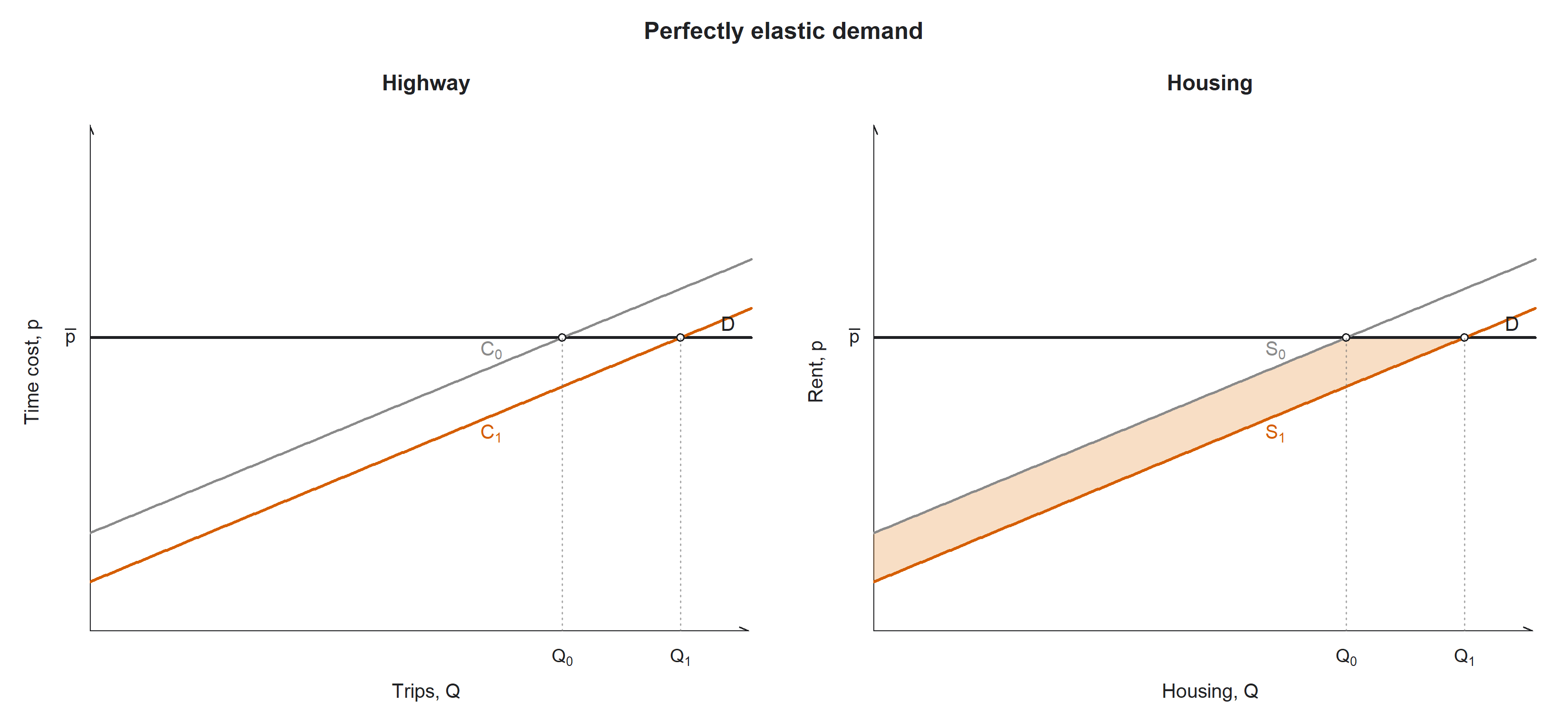
The welfare gains from adding lanes to the highway disappear!
With elastic demand, all you get for a new lane of highway are indifferent marginal commuters flowing in, and no one has a shorter commute. There are no suppliers to profit from the fact that the new road can produce the old quantity of trips at a lower cost, and new consumers are so ravenous for driving that they fill the highway back to the congestion it was at before, so there’s no benefit for the incumbent drivers either.
But the welfare gains from building houses remain. Although every consumer is indifferent to the supply shift and ends up paying the same price, just like with the new lane, the economy enjoys net welfare gains because those consumer’s rent payments aren’t just dissipated resources. Landlords collect their fixed rent for houses that now cost them less to produce.
We are finally ready to understand what’s so wrong with Weisenthal’s tweet.
Guy who thinks building more houses will depress prices but that adding more lanes to the highway won’t relieve congestion.
YIMBYs believe that extra highway lanes are useless because they won’t reduce congestion and Weisenthal is trying to extend this by analogy to houses.
But this analogy doesn’t apply. Even if demand for houses is as elastic as demand for highways and improving housing supply won’t lower prices, it will raise welfare because we’ll get lots of useful goods at the same price, but at a lower cost.
Again, we’re thinking about the derivative of welfare with respect to a small change in supply so the new entrants are indifferent although there is a small gray area of additional welfare shown on the graph.
Even if adding lanes doesn’t reduce congestion, it increases the number of people who can travel on the congested roads.
So if we manage to hasten the variably-tolled future, does that mean that building more lanes will become important again?