

Poverty is associated with a litany of negative outcomes in addition to the direct effects of material deprivation. For example: low educational attainment, high crime, poor health, food insecurity, high stress, homelessness, and more.
If this bundle of associated harms is the causal result of poverty, then the case for poverty-relieving transfers is bolstered. Not only do you get to transfer resources to higher-marginal-utility consumers, you also get to solve this long list of other social ills.
But the correlation between poverty and these outcomes is not sufficient to prove a causal link. It may be that a common ancestor causes both poverty and the associated “poverty bundle” or that causality goes the other way around.
Luckily, these kinds of income-raising transfers are among the most well-studied policies in economics. In his Public Economics lectures this semester, Raj Chetty introduced several extremely well-identified studies that separate the causal effect of income from its observed associations, which I cover below alongside several other studies from my own literature search.
All of these studies find that extra income increases consumption and leisure. So there’s no doubt that transfers relax budget constraints and make recipients better off. The question is: do they also solve the broader poverty bundle?
Wealth, Health, and Child Development
David Cesarini, Erik Lindqvist, Robert Östling, and Björn Wallace’s QJE paper answers this question using lottery players in Sweden.
There are two big advantages to the setting of their paper. First, Nordic administrative data contains extremely detailed, birth-to-death information on nearly all residents over multiple decades including data on physical and mental health, income, and intergenerational connections between parents and children. This gives the researchers a decades-long panel with nearly no attrition and enough detail to test the effect of income/wealth on dozens of important outcomes.
Second, Swedish lotteries have an extremely broad base of participation, in contrast to the highly selected group of lottery players in the US. Much of the sample comes from Prize-Linked Savings accounts, which offer lottery entries to bank account holders in place of interest, and around half of all Swedes hold such an account. Thus, the sample of lottery players barely differs from the general Swedish population in baseline health, income, education, fertility, or marriage.
So what are their results? First, on health. If you just naively correlate wealth with mortality, it looks like increasing wealth by 1 million SEK (about $140,000) decreases 10-year mortality by 2.8%, a big effect! Even after controlling for a broad array of baseline controls (like race, gender, education, etc) increasing wealth by $140,000 is still associated with around a 2% drop in 10-year mortality, both in the US and in Sweden. But these are just correlations and even after controlling for baseline demographics, there are non-random selection effects determining who ends up in the higher income brackets.
When we look at the effect of extra wealth on randomly selected lottery winners, the effects shrink to zero. The smaller points moving downwards on the graph below show the correlational effect of an extra 1 million SEK on 10-year mortality: The richer cohort is 2% less likely to die in 10-years. The larger, square points centered around the dotted line show the causal effect of wealth on mortality, which are always statistically indistinguishable from zero. If anything, the randomly selected lottery winners are slightly more likely to die within 10-years compared to similar lottery players who happened not to win.
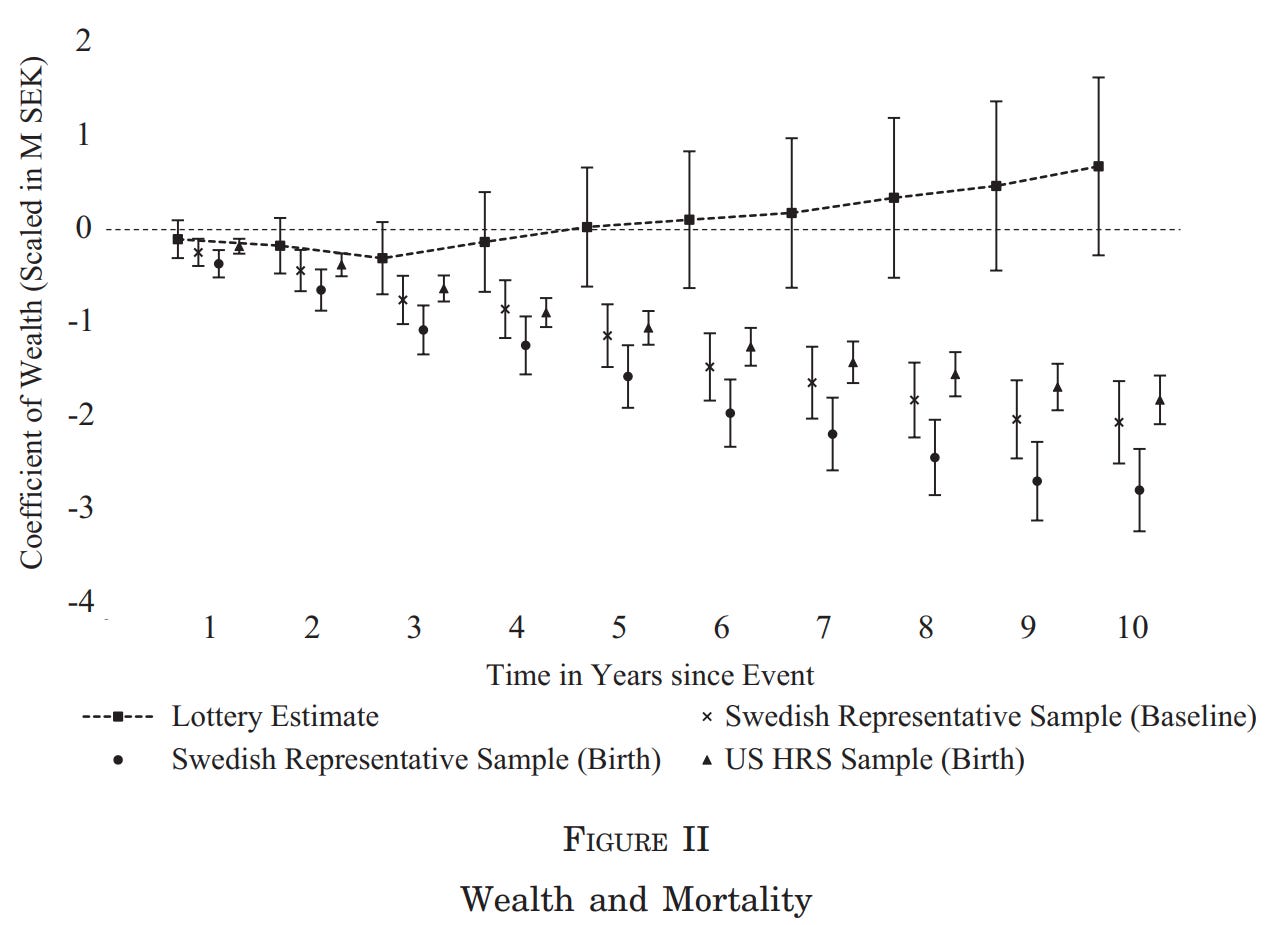
The causal effect of wealth on mortality is zero. That means that if you took someone from the poorer cohort, who is 2% more likely to die than someone with $140k in extra cash and you gave them $140,000, they would still be 2% more likely to die than the people who started with that money.
Put another way, the reason that richer people live longer is not because of what they can afford. It’s not because of better health care, private doctors, fancy food, safer cars, bigger houses, or longer vacations. If it was, then the people who win the money could buy those things too and get all the same benefits.1
This result cuts against most of the popular and academic theories for why the correlation between wealth and mortality exists. In particular, it discredits theories which put the ability of the rich to afford healthcare front-and-center in their explanations for why the rich live longer. It’s not true that poor people would have the same health outcomes as rich people if only they had the same resources.
This null result also opens new questions: If the causal effect of extra wealth doesn’t explain the correlation between wealth and health, then what does? Something still needs to explain why people with $140k of extra wealth are 2% less likely to die, just not something about resource constraints. That leaves reverse causality (poor health causing low wealth rather than the other way around) and common ancestor theories like behavior, culture, and genetics, to fill the gap.
The detailed data available in the Swedish context also allows the researchers to test the causal effect of parental wealth on the outcomes of their children. There is a large and robust correlation between parental wealth and child income, educational attainment, and health but whether this is a causal effect of parental income is not clear from these associations.
The random assignment in the lottery setting allows for identification of the causal effect. Across several measures of child health, behavioral outcomes (like drug use), and cognitive abilities (like educational attainment and test scores) the authors find precise zero effects. The graph below compares the cross-sectional association of parent wealth and children’s GPA, where $10,000 in extra annual parental income is associated with a 0.2 standard deviation increase in children’s GPA, to the causal effect of increasing a random set of parent’s income, which is indistinguishable from zero.
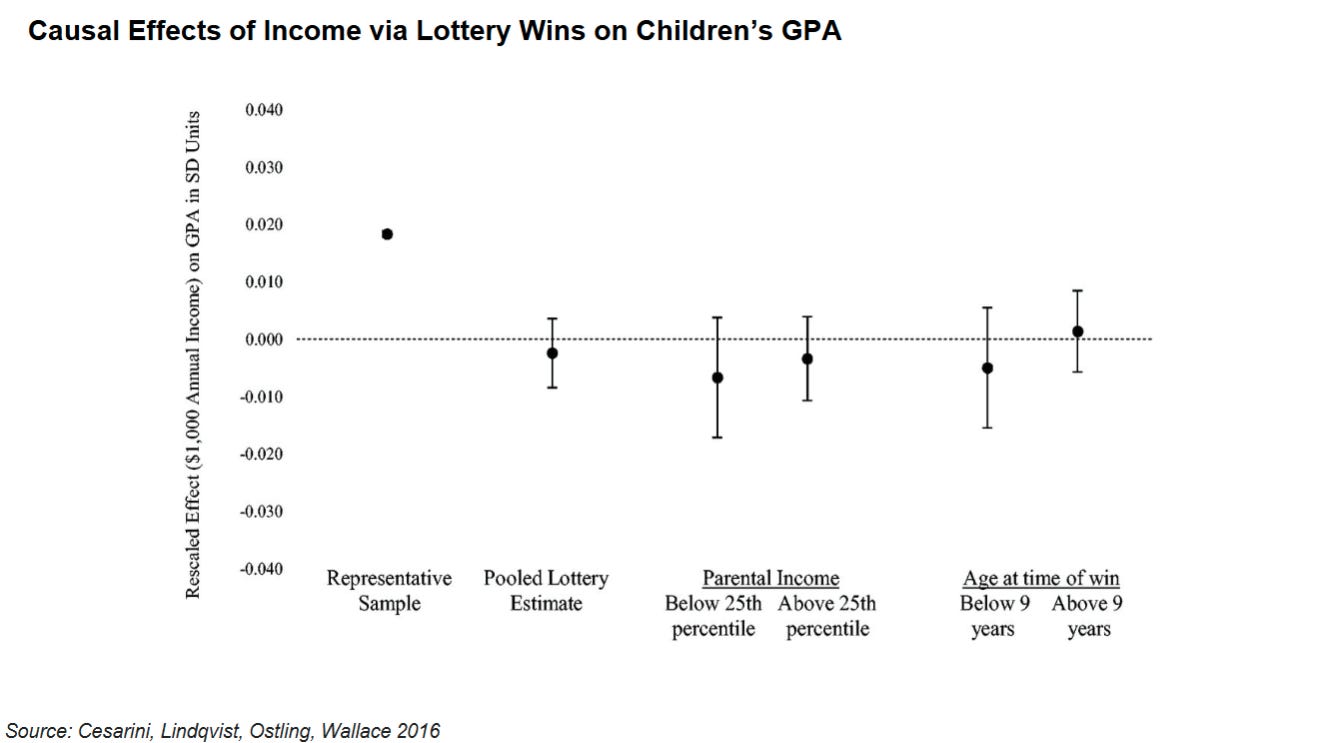
Again, the correlation between parent income and child outcomes is large and robust, but the causal effect is close to zero. Note also that the effect is zero even among low income households and households with young children. The authors tell us that “Replacing GPA in Figure III by any of the other five developmental outcomes gives substantively identical results.”
This means that the children of rich parents are healthier, smarter, and better behaved not because of the extra money their parents have but because of some other characteristics they inherit. It means also that bringing the incomes of people who are currently poor up to the incomes of people who are currently rich would not bring the educational, behavioral, or health outcomes of their children up to match.
These results leave open the question of what does cause the observed association between parents and children’s wealth, health, and other outcomes. Reverse causality is not a plausible explanation for the correlation between parent income and child outcomes, so a common ancestor theory where some factor which causes both high income for parents and good outcomes for children is most likely.
The Impact of Housing Assistance on Child Outcomes
I expect the main criticism of the Swedish lottery paper to be external validity. They have a sample large and varied enough to accurately measure the causal effects of income on Swedish people in Sweden, but these results may not generalize to other contexts. In particular, to countries with more poverty and less of a social safety net like the US.
The next paper extends the lottery design to a completely different group: impoverished households in Chicago who applied for housing vouchers in 1997. This program offered housing vouchers worth around $12,000 a year to families with an average income of $19,000. Most of the applicants were families headed by an unmarried African American woman whose children have an average GPA of 1.5 and attend highly disadvantaged public schools. The housing voucher program was far oversubscribed, so they allocated 18,110 vouchers randomly among the 82,607 applicants.
The authors of this paper (Brian Jacob, Max Kapustin, and Jens Ludwig) connect the voucher applications up to several other administrative datasets to track the impacts of voucher receipt on the children living in supported households. After correcting for multiple hypothesis testing, none of the outcomes they track for the children of winning parents are distinguishable from the control group: Test scores, high school graduation rates, crime rates, and hospital visits are unchanged.
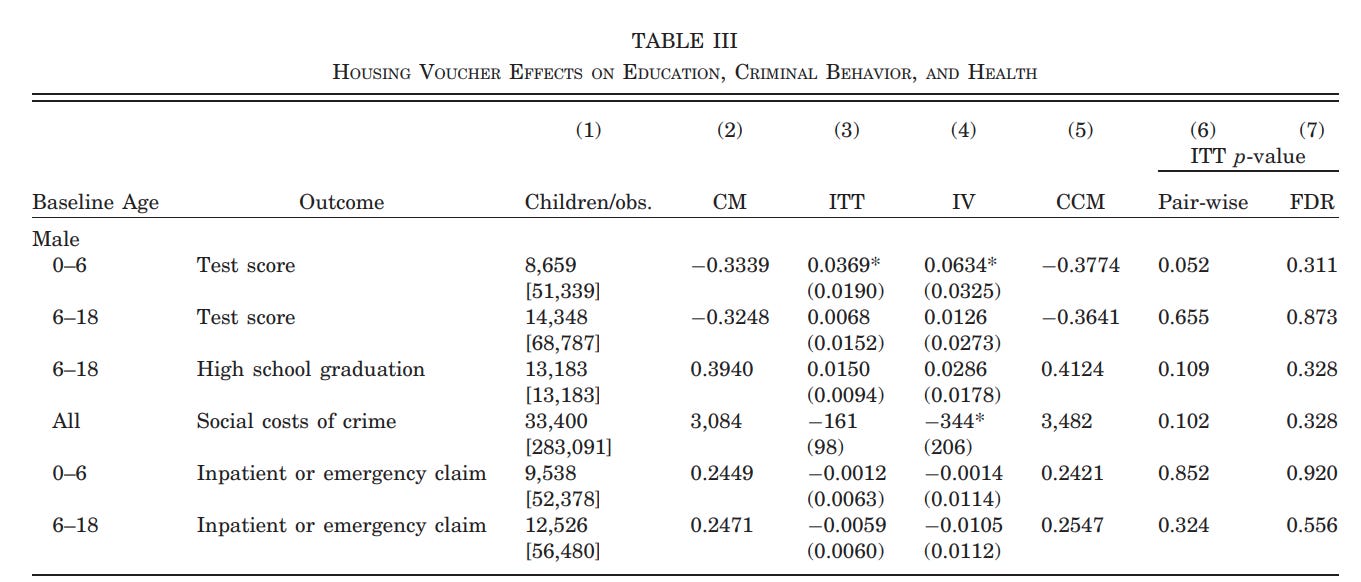
They measure fewer outcomes for the parents themselves but find in particular that recipients of the voucher do not move to neighborhoods with lower crime, lower poverty, better schools, or higher social capital. The recipients do reduce their labor force participation and labor income.
The author’s don't compare these causal effects to the correlations like the previous paper did, but going from $19,000 to $31,000 a year in 1997, after adjusting for inflation, is roughly equivalent to moving from the 17th to the 31st percentile income rank. Black male children with parents at the 31st percentile income rank compared to those at the 17th have about 16% lower incarceration, 18% higher college attendance, and 9% higher high school graduation rates. So again we see that the causal effect of parental income on child outcomes is much lower than the cross-sectional association, suggesting a causal mechanism that does not flow through spending money.
Race and Economic Opportunity in the United States
Another major motivation for transfers is to narrow gaps between historically advantaged and disadvantaged groups, like whites and blacks in the United States. Black Americans have lower incomes and tighter resource constraints on average which makes it difficult to access the levers of social mobility like education, healthcare, and good neighborhoods. So we might expect that transfers which ease these resource constraints increase the social mobility of the recipients and close racial gaps in income.
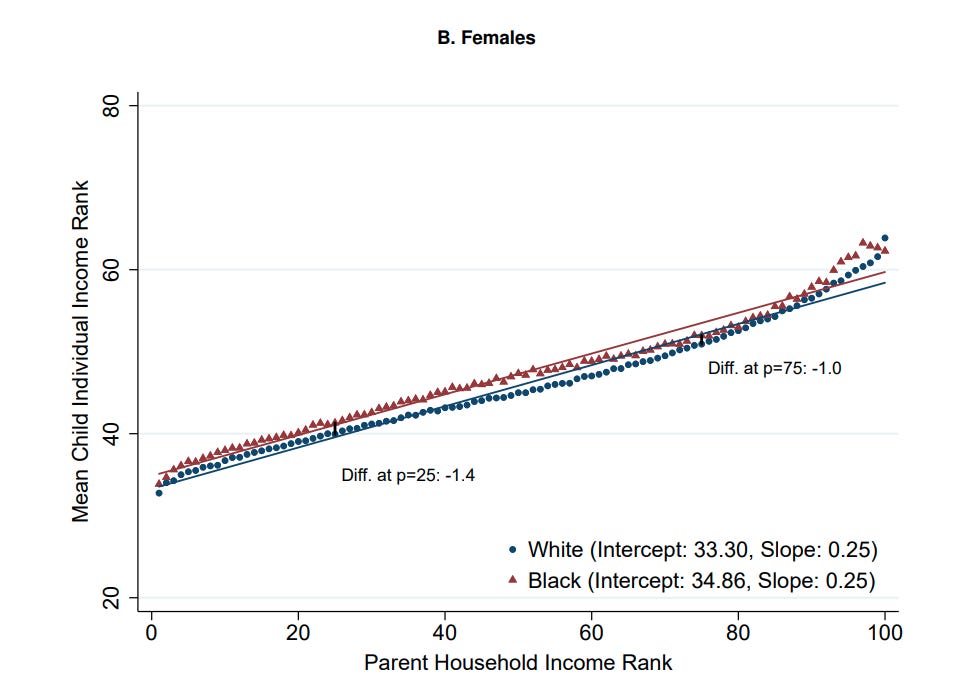
This paper, by Raj Chetty, Nathaniel Hendren, Maggie Jones, and Sonya Porter, does not run a direct test of the causal effect of income. Rather, it collects Census statistics on “virtually the entire American population from 1989-2015” and uses them to study the nature and causes of “intergenerational gaps”, i.e differences in children’s outcomes conditional on parental income across races.
These gaps are important because if they are small, then any point-in-time gap in average income between races will eventually shrink to zero and transfers can accelerate the process. Hispanic and white children, for example, have about the same average income conditional on parental income. There's still a gap in unconditional average income because Hispanic children tend to start with poorer parents. Over time, however, this gap will shrink. The richest-parent white children will regress towards the mean and the poorest-parent Hispanic children will rise towards it, eventually reaching equality.
But if intergenerational gaps between races are large, as they are between whites and blacks, then income differences by race will persist. A one-time transfer can move black parents up the current income distribution, but if it does not change the conditional mobility schedule, then the next generation is still drawn from the lower black mobility curve. The authors tell us that “transient programs that do not affect intergenerational mobility, such as temporary cash transfers, are insufficient to reduce disparities because income distributions will eventually revert back to their steady-states.”
The comprehensive Census data shows that the gap in intergenerational mobility between whites and blacks is the same size at every level of income. Thus, a resource-constraint theory struggles to explain these gaps and transfers are unlikely to close them. The children of Black parents at the 99th percentile of national income, with access to the most expensive housing, healthcare, and education, have the same expected income as the children of white parents at the 75th percentile.
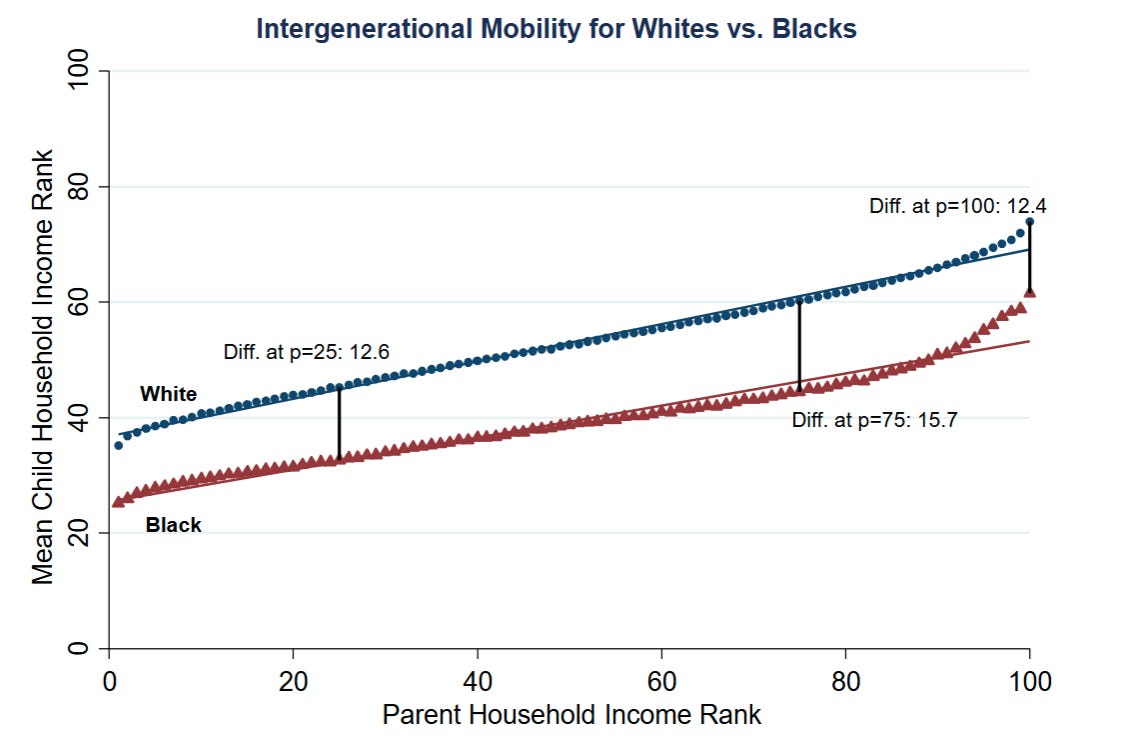
Similar results are seen for intergenerational gaps in wages, hours, employment, high school completion, college attendance, and incarceration. There is some evidence of higher incomes narrowing gaps in employment, incarceration, and high school graduation but other gaps still persist.


Chetty et al. suggest particular interventions that do seem to close these intergenerational gaps, like helping black children to move to neighborhoods with a high presence of black fathers, but straightforward transfers will not close these gaps because they aren’t caused by resource constraints.
A final important piece of evidence from this paper is that black females have almost zero (or even negative!) intergenerational gaps across all of the same outcomes. This gender difference narrows the set of possible explanations even further. Such a difference cannot be explained by a resource-constraint theory and it also rejects many theories based on genetics or on racism (which should both have similar effects on males and females).
Other RCT Evidence
The papers above are high sample, well-identified, and externally validated enough to make a strong case that many of the negative outcomes associated with poverty are not caused by resource constraints, but there is more evidence available.
In a previous post I covered three high-sample randomized control trials that also test the causal effect of income on a slew of possible outcomes (the fourth RCT was about the minimum wage).
The first trial relieved $169 million dollars of medical debt for a randomly selected group of 83,401 Americans over two years from 2018-2020. They find precise null effects on a range of economic outcomes like credit access, utilization, and financial distress. They find mostly no effect and a few determinantal effects on mental health and stress.
The second trial tests a UBI of $1000 a month over three years with a sample size of 1,000 treated participants and 2,000 controls in the United States. They find precise null effects on health, career prospects, and investments in education. After the first year even measures closely connected to income like food insecurity didn’t differ between the treated and control group.
The final RCT on the effect of income is the Denver Basic Income Project which also tested a UBI of $1000 a month but enrolled only homeless people and did not find any statistically distinguishable impact of the extra money on homelessness rates.

Bruce Sacerdote tracks adopted children who are randomly assigned to families to test the effect of parental characteristics on child outcomes. Parental income is highly correlated with biological child income, but has zero effect on adopted child income. Parental educational attainment has some transmission to adopted children, but much smaller than for biological children. Other outcomes like smoking, drinking, and obesity are about the same.
Cesarini et al. have another study of Swedish lottery winners that finds zero effect of income on criminal behavior, even though the cross-sectional relationship is large.
Counterexamples
The strongest counterexamples to the null effect of income on the “poverty bundle” come from developing countries. In Morocco, a small cash transfer to fathers in poor rural communities produced large gains in school participation. In South Africa, an expansion in old-age pension payments to black families improved infant height and weight for girls when the money was received by women, but not for boys and for no one when it was received by men. In Kenya, a $1,000 cash transfer reduced infant mortality by 48% and under-five mortality by 45%, with effects operating through maternal nutrition, hospital delivery, and reduced labor around childbirth. Transfers in-kind or cash incentives for child medicine, especially against malaria in West Africa can reduce child mortality by nearly 80% and can save a life for only $4,000.
There are also developed-world counterexamples. Dahl and Lochner use EITC expansions and estimate that a $1,000 income increase raises math and reading scores by about 6% of a standard deviation in the short run. Duncan, Morris, and Rodrigues use random-assignment welfare and antipoverty experiments and estimate a similar 5–6% standard-deviation effect on young children’s achievement. Milligan and Stabile use Canadian child-benefit variation and find positive effects on test scores, maternal health, and child mental health. Akee et al. use a quasi-experiment based on Native American reservation casino taxes and find that an extra $4,000 per year for the poorest households increased educational attainment by one year and reduced minor crime among teenagers by 22%.
I think there are two explanations for these counterexamples. The first is diminishing returns to income. In Africa, and perhaps in the poorest parts of the United States, extra income flows towards the most basic levels of nutrition, medical access, reduced maternal labor, school attendance, and other goods with extremely high marginal returns. In Sweden, Chicago, or modern Canada, many of those margins are less binding, so the same transfer mostly buys ordinary consumption rather than large changes in mortality, crime, or educational attainment.
The second explanation is that the developed-world counterexamples often study programs with price as well as income effects. The EITC, for example, requires work and so changes incentives rather than just income. Welfare experiments in general combine money with program rules, work requirements, and benefit formulas. There is also just an expected dispersion of estimates in any literature. None of these papers should be dismissed, but they do not overturn the cleaner lottery and RCT evidence showing weak effects of pure adult wealth shocks on many outcomes.
Conclusion
None of this evidence means that transfers are useless or that they have zero effects. Sending money to those in need increases their consumption and leisure, which is valuable in its own right. But the evidence suggests that giving people more resources won’t solve all the other problems associated with poverty, at least in the developed world.2
This is policy relevant because many arguments in favor of transfers rely on the resource-constraint theory. The National Academies’ child-poverty report, for example, frames child poverty as causing large social costs through lower adult productivity, higher crime, and higher health expenditures. It then argues that policy packages cutting child poverty would cost far less than the harms they prevent. But if the causal effects of transfers on these margins are weak, then transfers are much less likely to “pay for themselves” through large downstream improvements in health, crime, education, and productivity.
Understanding that many of the bad outcomes associated with poverty are not caused by low incomes is also important if you want to actually improve those outcomes! We’ve eliminated one possible causal theory, but the actual cause is still unclear. If we want to improve health, reduce crime, raise educational attainment, and increase mobility, we need to identify the mechanisms that actually produce those outcomes and target them directly.
We shouldn’t be oversold on the impacts of income transfers. They give people more money, which can be worth a lot. But the case usually made rests on a larger set of promised effects on health, crime, schooling, and mobility. In the developed world, these effects are absent in the best-identified research.
It could be that the association between wealth and health is because of something that rich people spend money on, but when you give poorer people more money they choose not to spend money on the same things. I don’t think this objection works in this context because of separate evidence that spending on health care spending has little association with health outcomes. Plus, this theory still points towards some behavioral difference in what people choose to spend money on as the cause of the association between wealth and other outcomes rather the direct effect of resource constraints, which is the mainstream theory.
This is not inconsistent with the view that rising GDP per capita and technological progress are extremely important. First of all, increasing someone’s consumption and leisure is important and valuable even if it doesn’t increase their college attendance, say. Second of all, economic growth and technological progress are much more than just increasing everyone’s consumption. In particular, they expand the set of goods that exist and are even possible to consume which can improve outcomes like life expectancy by making medicine more effective even when spending on medicine stays constant.
Another great paper looks at elite Chinese families who were thrown into poverty during Mao's revolution.
All of their land and jobs and money were taken. But within 3 generations these families were back on top of the income scale.
A negative income shock was temporary.
Kids need two parents more than money