

My paper on housing construction and the Endangered Species Act, The Costs of Environmental Land Use Regulation, has just been published in the Journal of Public Economics.
The central idea of the paper is that the Endangered Species Act creates hundreds of natural experiments testing the effect of environmental land use regulation. The law prohibits construction when it might cause harm to an endangered species. To lift this prohibition, you need an permit from the US Fish and Wildlife Service.
Crucially, however, this prohibition on construction only applies when endangered species are nearby. So when the Riparian Woodrat, say, was added the endangered species list, the cities and towns that happened to be near its habitat in the San Joaquin valley got an extra layer of land use regulation, but other, similar towns in central California did not. Since the Woodrat’s habitat is not plausibly correlated with other underlying economic or demographic factors that drive housing construction, this is a good natural experiment testing the effect of the ESA’s land use regulations. The ESA creates hundreds of these experiments across hundreds of species listings.
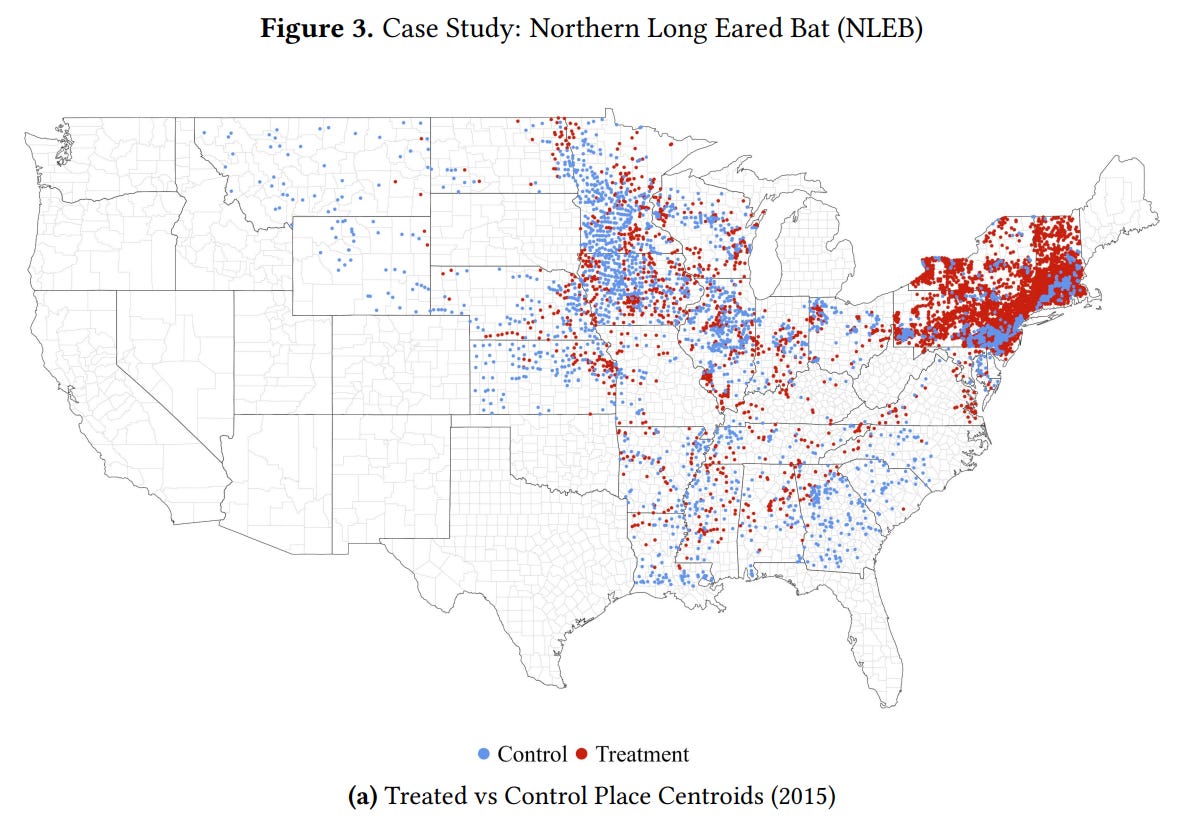
The map below shows the same natural experiment but for a different listing of the Northern Long Eared Bat (NLEB). This is the largest species listing since 1967 with over 1.5 million square kilometers of habitat. The dots in red represent local permitting offices with jurisdictions inside the NLEB habitat and the blue dots represent those outside of it.
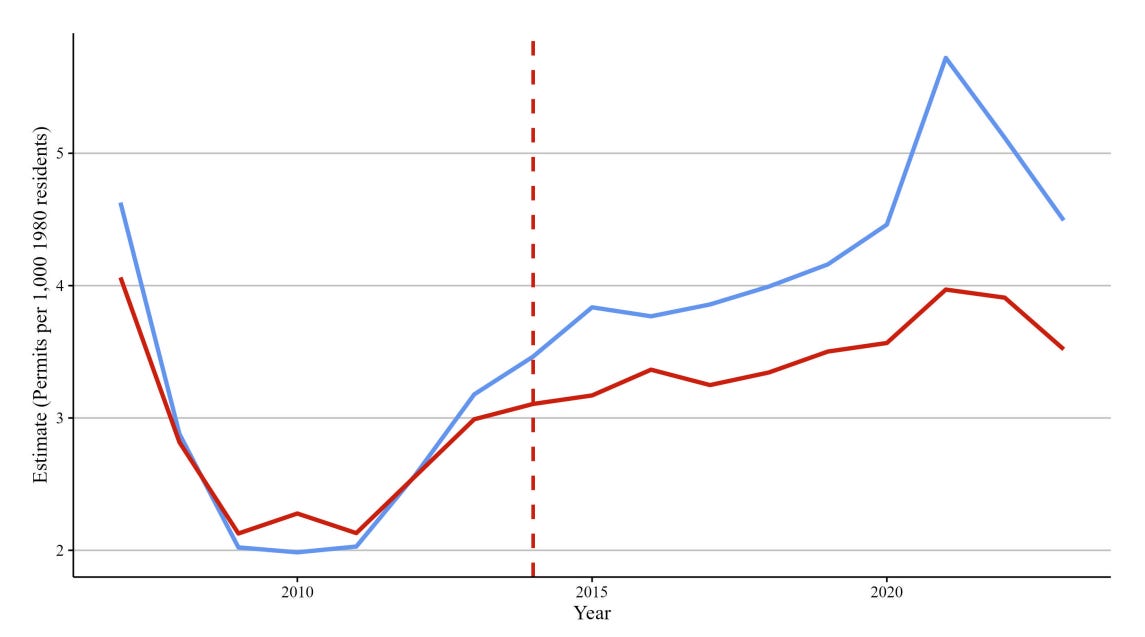
The next graph plots the average annual per capita permit flows in the blue control group and the red treated group. Through the housing crisis collapse and recovery the two groups move in concert. Only after the species listing differentially treats the red group with stricter land use regulation do their permitting trends diverge, suggesting that the change in regulation is responsible.
Across all 661+ endangered or threatened animal listings, I find the same story. Before a given species is added to the endangered species list, places inside and outside the habitat have the same trends in annual permit flows, indicated by the dots hovering uniformly around zero below. After the ESA listing, places inside endangered habitat start issuing -0.52 fewer permits per 1,000 1980 residents annually, about a 10% reduction.
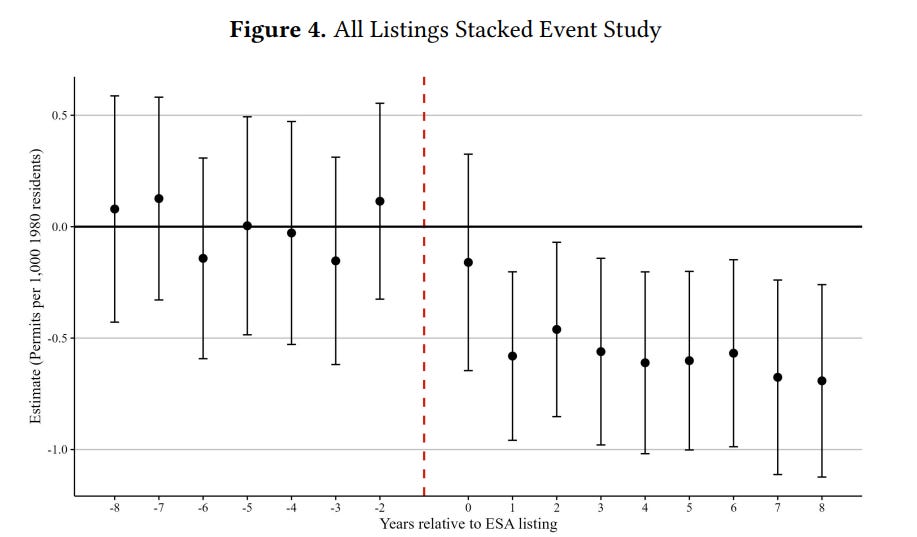
This same effect shows up in reverse after de-listings: places in endangered habitat increase their permits relative to similar places outside of the habitat after an animal is removed from the endangered species list.
Importantly, the slowdown in permitting after ESA listings shows up both in extensive margin greenfield development and in infill construction in already-developed areas. The tradeoff between housing and species protection is hard to evaluate at the extensive margin, but it’s not binding on the intensive margin so any development slowdown there is a pure welfare loss.
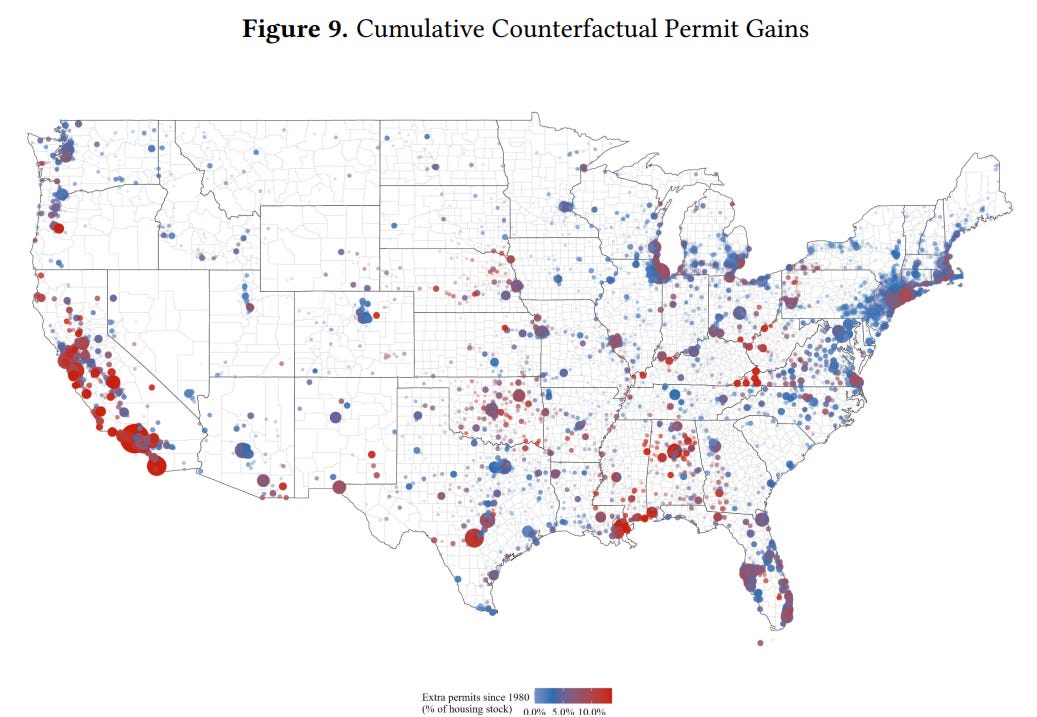
Each species listing lowers annual permit flows by 10% in the permitting jurisdictions nearby the listed habitat. There have been hundreds of new additions to the endangered species list since 1980 and endangered species habitats now cover the vast majority of the country. Adding up the implied effects across all of these listings I find that the ESA has reduced US housing stock by around 6.3 million units since 1980, which is about 4% of 2025 housing stock. Without the several hundred ESA listings since 1980, the US would be permitting hundreds of thousands of additional units annually with gains concentrated in major metro areas and especially coastal California.
The End of the Endangered Species Act?
Earlier in July the US Fish and Wildlife Service published a final rule that, after 15 months of deliberation, rescinds the definition of “harm” that has underpinned the enforcement of the ESA since 1975 and thus narrows the set of actions that violate the ESA.
This rule change could, if it survives challenges in court and subsequent administrations, fundamentally change the ESA and remove the major features that turned it into a land use regulation in the first place.
How can simply removing the definition of one word, and not even replacing it with anything, change the law so much?
Well, the current definition of harm (current until the new rule goes into effect in September) is
an act or omission which actually injures or kills wildlife, including acts which annoy it to such an extent as to significantly disrupt essential behavioral patterns … significant environmental modification or degradation which has such effects is included within the meaning of ‘harm’
According to the USFWS in their notice for this definition change, the current definition of harm
dramatically expanded the plain meaning of ‘‘take,’’ to sweep in (and thus prohibit) actions that impair the habitat of protected species.” and “transformed section 9 from a prohibition on private citizens hunting, capturing, or otherwise attempting to kill or injure certain specifically protected animals into a sweeping land-use regulation. (emphasis original)
It is very clear that they are trying to undo this transformation of the law into a land-use regulation.
Concretely, they rescind the definition of harm that broadens prohibitions to acts or omissions that disrupt behavior, breeding, or significantly modify habitat. But they don't replace the definition with anything else. Instead, they fall back on the definition of "take" itself, where "harm" was just one of 10 other verbs that take was supposed to include.
Specifically, they mean to follow Justice Scalia's interpretation in his dissent of Babbit v Sweet Home, which they cite and praise several times. Scalia's definition of take is far, far narrower than the previously standing one and would seem to me to exclude nearly all construction and agricultural activities on private land.
To "take," when applied to wild animals, means to reduce those animals, by killing or capturing, to human control … hunting, killing and capturing.
It is obvious that "take" in this sense-a term of art deeply embedded in the statutory and common law concerning wildlife-describes a class of acts (not omissions) done directly and intentionally (not indirectly and by accident) to particular animals (not populations of animals).
Essentially, the idea is that this prohibition on take in Section 9 is about poaching. The broader seeming "harm" and "harass" are subordinate to the narrower "pursue, hunt, shoot, wound, kill, trap, capture, or collect" in the definition of "take."
Scalia gives several convincing arguments in favor of this interpretation in the dissent. First, noscitur a sociis, a word is known by the company it keeps. In addition to the other verbs listed above that color the meaning of “harm” and “take,” he also refers to the law’s other prohibitions on import, export, sale, and possession of taken endangered species as well as provisions to allow the forfeiture of guns, traps, nets, and other equipment used to aid the taking of protected animals.
If the word “take” was meant to include the kind of unintentional and indirect harm that comes from, say, stormwater runoff in a construction site, then Congress’ use of the word doesn’t make sense in these other topics. If you “take” an animal by cutting down a tree that they might use to breed a year from now, there is nothing from that animal which you can export and there are no guns or traps involved. Thus:
[The ESA] plainly relates to "taking" in the ordinary sense. If environmental modification were part (and necessarily a major part) of taking, as the Secretary maintains, one would have expected the list [of forfeited equipment] to include "plows, bulldozers, and backhoes."
Second, the principle that:
Where Congress includes particular language in one section of a statute but omits it in another ... it is generally presumed that Congress acts intentionally and purposely in the disparate inclusion or exclusion.
The application of this principle to the ESA is particularly clear. Section 9 of the ESA prohibits all persons from taking endangered species. Section 7 of the ESA prohibits the federal government from taking endangered species and from modifying designated critical habitat. Because the law specifically bans habitat modification in Section 7, it can’t also imply that habitat modification was already banned by Section 9 or else the explicit ban would be useless.
Scalia’s interpretation would exclude nearly all private activities that aren’t directed towards endangered animals from the definition of take even if they do in fact kill endangered animals.
[the broad definition of harm] produces a result that no legislature could reasonably be thought to have intended: A large number of routine private activities-for example, farming, ranching, roadbuilding, construction and logging-are subjected to strict-liability penalties when they fortuitously injure protected wildlife
Without the regulation, the routine "habitat modifying" activities that people conduct to make a daily living would not carry exposure to strict penalties; only acts directed at animals, like those described by the other words in § 1532(19), would risk liability.
Under Scalia's interpretation, the incidental take permits, which today are required for all kinds of construction activities even minorly associated with harm to endangered species, are meant to permit other activities that are still directed at taking animals, like commercial fishing, that incidentally take endangered animals as well.
There is a wide range of actions that would be considered take under the previous interpretation, but not under Scalia's interpretation. To take an extreme example, if you're building a subdivision of homes and you bulldoze land that you know to contain endangered gopher nests and you know that bulldozing will kill them, that is definitely take that requires a permit under the previous rule. But under Scalia's interpretation this is not take because the action is not directed at the gophers. You're building a house just as you otherwise would. You're not pursuing the gophers at all or "reducing them to man's dominion and making them the object of profit."
If the gopher nests make the building structurally unstable and you have to root out and exterminate them to make your building work, that would still be take. Other, less extreme examples might include cutting down trees that are habitat for endangered migratory birds, but those birds aren't there right now. That's take under the previous rule, but not take under Scalia's interpretation.
Now, again it's unclear how fully the USFWS will adopt Scalia's position here. In a footnote in the final rule on a response to a public comment, the USFWS says "actions that directly result in injury or death to listed wildlife still constitutes ‘take’" which seems to contradict Scalia's interpretation that result is insufficient to constitute take and that direction and intent are also required. But elsewhere they say "We adopt Justice Scalia’s rationale as articulated in Sweet Home and conclude that the Services’ regulatory definitions are unlawful" and they repeat his preferred definitions of take elsewhere in the rule and comment responses.
Also, the shift to Scalia’s interpretation of the law changes much more for purely private construction than it does for projects involving the federal government. The definition change weakens Section 9, but Section 7 already put stronger standards on federal actions and those standards don’t depend on the broad interpretation of the word “harm.” Most housing construction doesn’t require any federal land, permits, or funding but other construction, like energy, transportation, or land reclamation projects, often does so they are covered by Section 7 and thus not affected as much by this change.
Still, if Scalia’s interpretation is adopted and it holds up in court, it would be a huge change to the ESA and the landscape of housing construction in the US.
My paper can produce a useful back of the envelope calculation on how this change would affect housing construction. Specifically, take the comparison between full listings and plant (partial) listings in Figure 7.
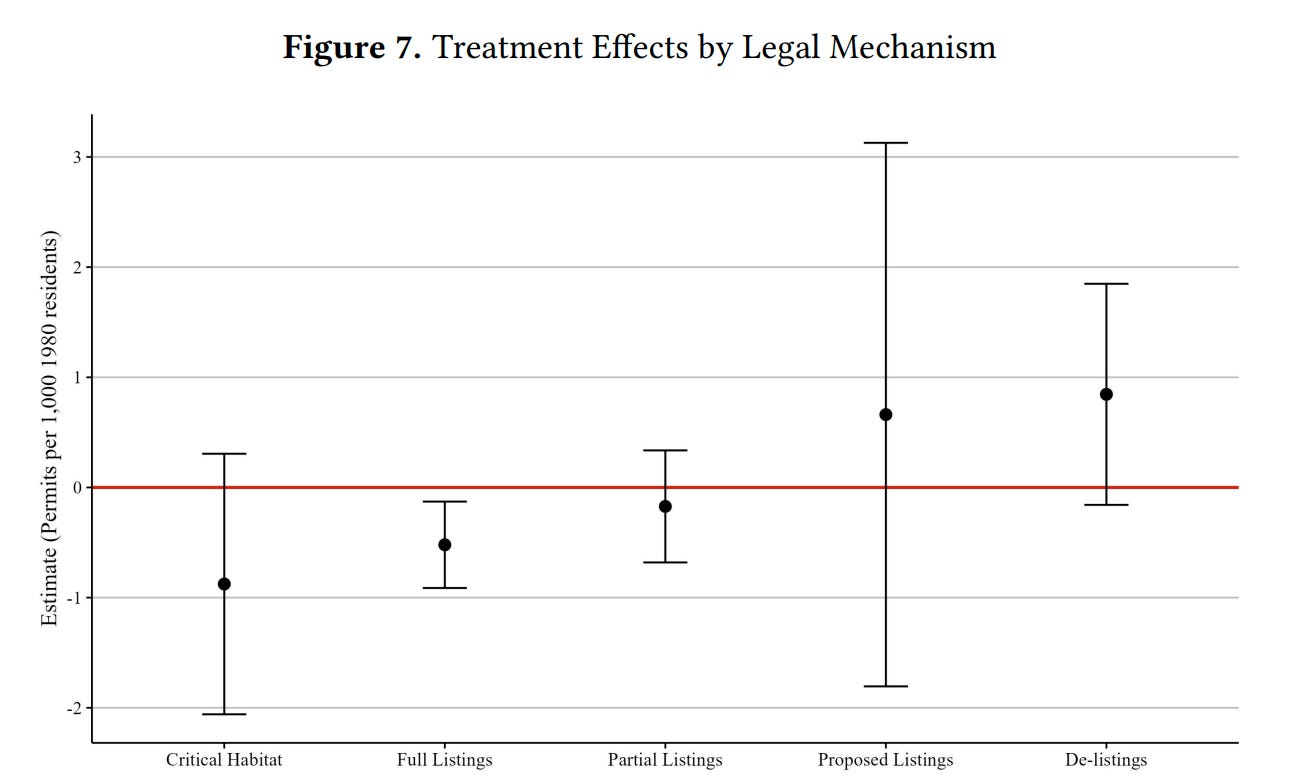
Endangered plants still have some restrictions on e.g import/export, but they do not have protections against take under Section 9. So endangered plants on private land can be removed in the course of construction, for example, with no liability or permit. They are protected from take and habitat modification on federal lands under Section 7. So the legal position of plants is similar to the legal position of endangered animals on private land under this new rule.
The treatment effect on plant listings is only about 30% as large as the treatment effect on animal listings, and insignificant. Carried through in aggregate, this might raise national permit flows by perhaps more than 200,000 permits a year.
This is probably an upper bound though because animals will still have somewhat more protections than plants even under the new rule, pre-existing habitat conservation plans will remain, and critical habitat prohibitions are unchanged.
If I aggregate the treatment effect where animal listings with no critical habitat get the lower, plant effect but animal listings with critical habitat get the full-size treatment effect, that implies around 100,000 extra permits per year.
100,000-200,000+ permits per year is a massive policy change and that is only on the margin that I can measure using the results from my paper. The ESA is surely also an important constraint on energy and infrastructure construction so these too may get easier as the law weakens.
Fascinating, Max. Thanks for sharing!
Very thankful that the next president will redefine harm again to destruction loss of habitat. Hopefully a law will be passed to permanently enshrine this definition so no future Republicans can undo that measure.